
Player Equipment
All players participating in Piedmont Soccer Academy (PSA) practices, games, scrimmages, and other club activities are required to wear proper equipment at all times. These requirements are mandated by Georgia Soccer and U.S. Soccer and apply without exception.
Required Equipment
Shin guards must be worn at every practice, game, scrimmage, and soccer activity — no exceptions.
Soccer socks must be worn over the shin guards and must fully cover them from top to bottom. Shin guards go on first; socks go on over them.
Footwear must be soccer cleats or athletic sneakers. No other footwear is permitted.
Prohibited Items
For player safety, no jewelry of any kind may be worn during play, including earrings, necklaces, bracelets, watches, or hair beads. This also includes any item that could hang loose or pose a risk of injury to the player or others on the field.
Players arriving without required equipment, or wearing a prohibited item, will not be permitted to participate until the issue is corrected.
GOAL SAFETY AND NETS
All players enjoy scoring goals. Our goals and nets attract players during practices as well as before or after the game.
From a younger player's perspective, the goals are similar to a jungle gym. They appear safe to climb on and play around. However, they can flip and cause injuries! Additionally, climbing on the nets damages the nets - nets are expensive!
As parents and coaches, we are responsible for keeping all of our players and their guests safe. And keeping the goals in good condition. To maintain the nets and keep the goals safe, Piedmont Soccer Academy (PSA) has developed the following policies:
Absolutely no climbing on or hanging from the goals!
No climbing or playing in the nets!
During all practices and games, goals are to be secured by sandbags to prevent flipping
After practices and games, goals are to be secured and locked
Let's keep our pitch safe and our players smiling!
Concussion awareness
Concussions are a major concern for player health and long-term sports/life enjoyment. Georgia Soccer and most sports organizations have started training programs to recognize the ways concussions occur, the signs of a possible concussion, and what to do if a concussion is suspected. Failure to recognize a concussion and take appropriate steps can jeopardize the player's well-being and long-term quality of life.
At the June 2013 Piedmont SA Board Meeting (in the interest of players' safety and well-being), the board voted to require all coaches and trainers to take an online course provided by the CDC and to encourage all players/parents to take it as well. The course takes about 30 minutes to complete and is designed to help coaches, parents, players, and game officials recognize the signs of a possible concussion and know what actions to take if a concussion is apparent or suspected.
Once completed, you can print a certificate of completion. Coaches and Trainers are required to submit the certificate to the Director of Coaching upon completion. Parents and players can keep the certificate or turn it in to a Piedmont SA board member. We suggest you keep a copy for yourself. Piedmont SA is also looking into “at the pitch training” for parents and players who may not have internet access.
Your board is hoping all players and parents will voluntarily take the online course or participate in “at the pitch training“. At this time, the board does not wish to require all players and parents to participate; instead, the board hopes all players/parents will recognize the serious nature of concussions and learn how to identify a suspected concussion and what actions to take.
The CDC HEADS UP to Youth Sports: Online Training is available to
coaches, parents, sports officials, athletic trainers, and other individuals interested in learning about concussion safety.
You can access the online CDC course at:
CDC Heads Up Training
Weather Policy
In the event of inclement weather, Piedmont SA will determine if the fields are playable for practice and games. Deciding factors include the amount of rain, thunder/lightening, and if damage to the fields may have occurred. Coaches, parents, and players may also check the current field conditions posted on the club’s website.
Practice Days
1) A decision will be made by 4:30 PM to determine the status of the fields.
2) The website will be updated by 4:30 PM based on the inspection of the fields.
Game Days
1) A decision will be made by 7:00 AM to determine the status of the fields for games.
2) Our website will be updated by 7:00 AM.
Primary Status Notification
1) Social Media will be the first place updated. Please make sure you follow us there.
2) If you are currently signed up with us and have an email account, you will receive an email if the fields are closed.
3) Our Website will also be updated to show field status.
Lightning and Thunderstorm Safety
Lightning strikes fast - is unpredictable - and dangerous!!
At the first strike, Piedmont SA will follow the rules set forth by Georgia Soccer.
All playing areas of the pitch will be closed and remain closed until 30 minutes after the last strike, flash, or thunder.
All players, parents, guests, and coaches must clear the fields (pitch) and go to a safe area inside a building or inside their car.
After the storm has passed, Piedmont Soccer Academy will determine whether it is safe to resume play and whether the pitch is safe for play.
Waiting in the area around the pitch, restrooms, or concession area is not safe during a thunderstorm. There is metal all around that can attract and carry a lightning current. Go relax in your car and listen to your favorite music or play your favorite game on your cell. Your car is grounded and is the safest place in the pitch area for you and your kids. Even safer - go to a local restaurant or shop during the storm. Once the storm has passed, stop back by the pitch to see if play will resume.
Cold Weather Overview:
Many Piedmont SA Club teams continue to train outdoors during winter. The following guidelines are for the safety of both coaches and players and should help determine whether sessions should be modified or canceled.
Factors to Consider:
- Barrow County prohibits using turf fields whenever snow or ice is on the pitch. Users are not permitted to remove these, so any time there is snow or ice on a field, practices are canceled.
- The Wind Chill Factor should be considered. Based on temperature, wind speed, sun exposure, and humidity, this figure is calculated to assist people in determining the relative discomfort reasonably expected by anyone planning prolonged time outdoors.
- While coaches’ discretion is the determining factor, we suggest that practices for the youngest players be suspended if the wind chill is below 45 degrees. Older teams, such as high school-age groups, should also consider this indicator when determining whether to hold sessions.
- Please note that PSA reserves the right to cancel all sessions for teams on evenings when the club determines that field or weather conditions warrant such action in the best interests of all players and coaches.
Cold Weather Attire:
Piedmont SA encourages all players and staff to dress appropriately. In cold weather, warm-up pants, jackets, sweatshirts, and thermals are recommended. Additionally, gloves or mittens and hats or earbands are recommended, as the head and outer extremities are among the first areas to lose body heat.
Coaches are encouraged to speak to any players who are not appropriately dressed and determine whether they should be dismissed for safety’s sake.
Hydration helps prevent hypothermia, as dehydrated bodies cannot regulate their temperature in cold weather, much as dehydration causes problems in extreme heat. Teams should take regular water breaks, no matter the temperature.
Practices may be shortened at the coach’s discretion. All warm-ups should be of appropriate length to fully prepare players for training, and sessions should include minimal periods when players are not moving.
Cold Weather Guidelines:
Cold Index Guidelines
46° and higher No Change
45° and lower Allowable Additional Clothing:
- Layered beneath uniform (for example)
- long sleeves
- long pants
- additional socks
- Gloves or mittens
- Stocking caps without straps
- Sweat pants or shirts - In the case of extremely cold weather, may be worn underneath the uniform, provided the entire team uses the same color sweats
- Jackets may be worn under the uniform so that referees can see the player's number if a card is issued.
Clothing NOT Allowed:
- Hooded sweatshirts
- Hoods and strings present possibility of being grabbed
- Ear muffs (headbands OK)
- Plastic or metal part crossing the top of the head presents potential hazard
- Scarves
40° and lower Shorten games by 5 min/half & practices to 45 min
35° and lower Suspend games and practices
Step One - Determine Wind Chill Temperature
Our official website to determine wind chill can be found by clicking here
Cold weather can affect health and safety during practices and games. The definition of “cold stress” varies across the United States, depending on how accustomed people are to cold weather. A player from Minnesota will have a much different threshold for cold than a player from Florida.
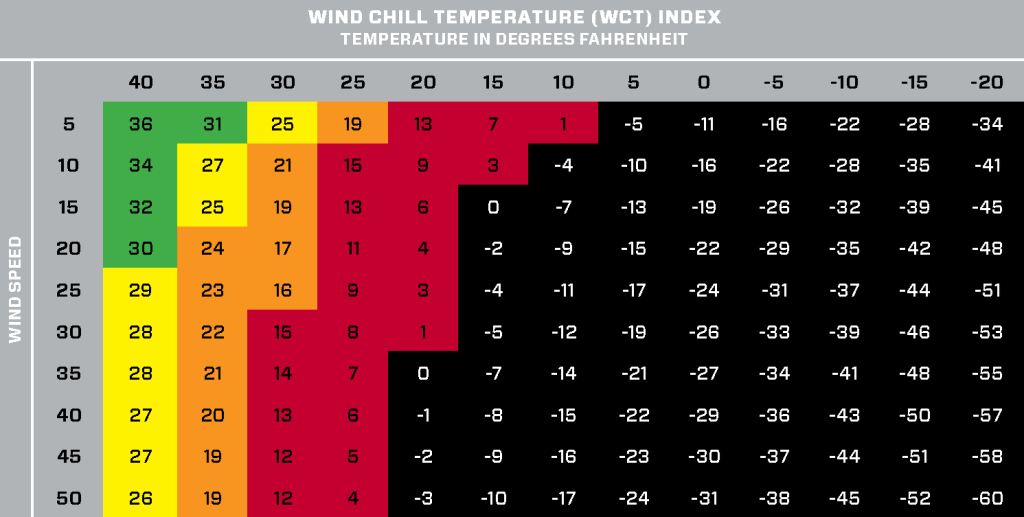
NOTE: This table was adapted from the NOAA and NWS. It is calculated using the following formula: Wind Chill (ºF) = 35.74 + 0.6215T - 35.75(Vˆ0.16) + 0.4275T(Vˆ0.16), where T = air temperature and V = wind speed (mph).
Step Two - Find Your Alert Level
Use this chart to determine the alert level at your location based on wind-chill temperature.
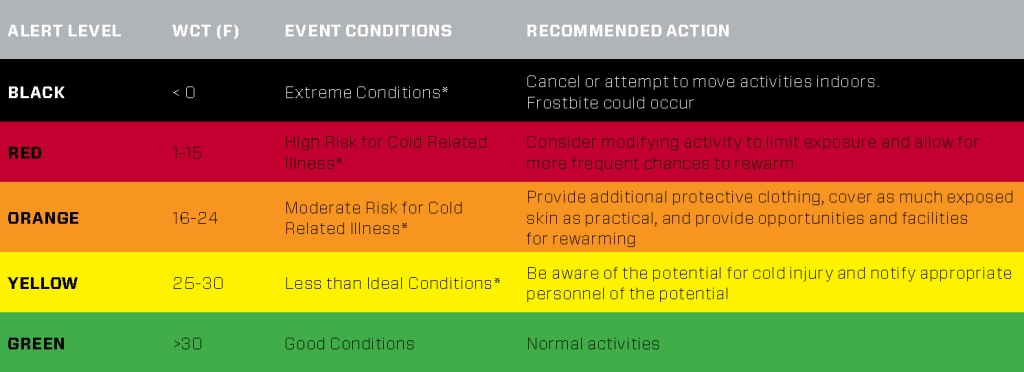
* In wet environments with colder conditions, the following situations are accelerated. Use additional caution to recognize potential cold injuries. (NOTE: These WCT guidelines were adapted from the NATA position statement: Environmental Cold Injuries by Cappaert et al. 2008.)
Piedmont Soccer Academy follows U.S. Soccer Recognize to Recover Program guidelines for playing in heat.
These guidelines use a Wet Bulb Globe Temperature (WBGT) reading; for example, a WBGT reading of 92 degrees is somewhat comparable to a Heat Index reading of 104 to 105 degrees.
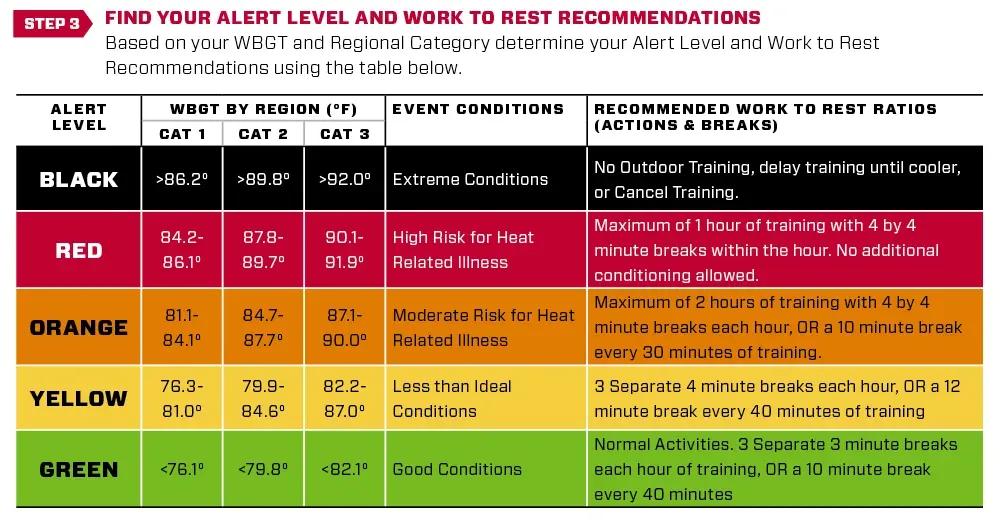
For practices in Georgia, when the WBGT is 92 degrees or above, training/practice should be suspended until it is cooler.
For games in Georgia, when the WBGT is between 84.2 and 92 degrees, water breaks of 4 minutes should be provided every 30 minutes of play. If conditions are hotter or the game is on artificial turf, two water breaks per half may be necessary.
Why does cancellation apply to practices but not games?
There are enough built-in opportunities for players to get rest and hydration breaks throughout a game; not everyone on the team is participating intensely at one time. Officials and coaches are available to monitor 22 or fewer players in a game setting, while coaches may have 100 or more players to monitor in a practice setting. Club administrators and tournament officials are responsible for monitoring the WBGT and keeping the participating teams and game officials informed of the heat index. Coaches are encouraged to also monitor the conditions.
Who's in charge?
Typically, in the run-up to a game or practice, the club or organization makes the judgment call. Once players arrive and the game is underway, the officials on the field have the decision authority. This would be referees (who typically will consult with the coaches), or coaches if the event is a practice or other gathering.